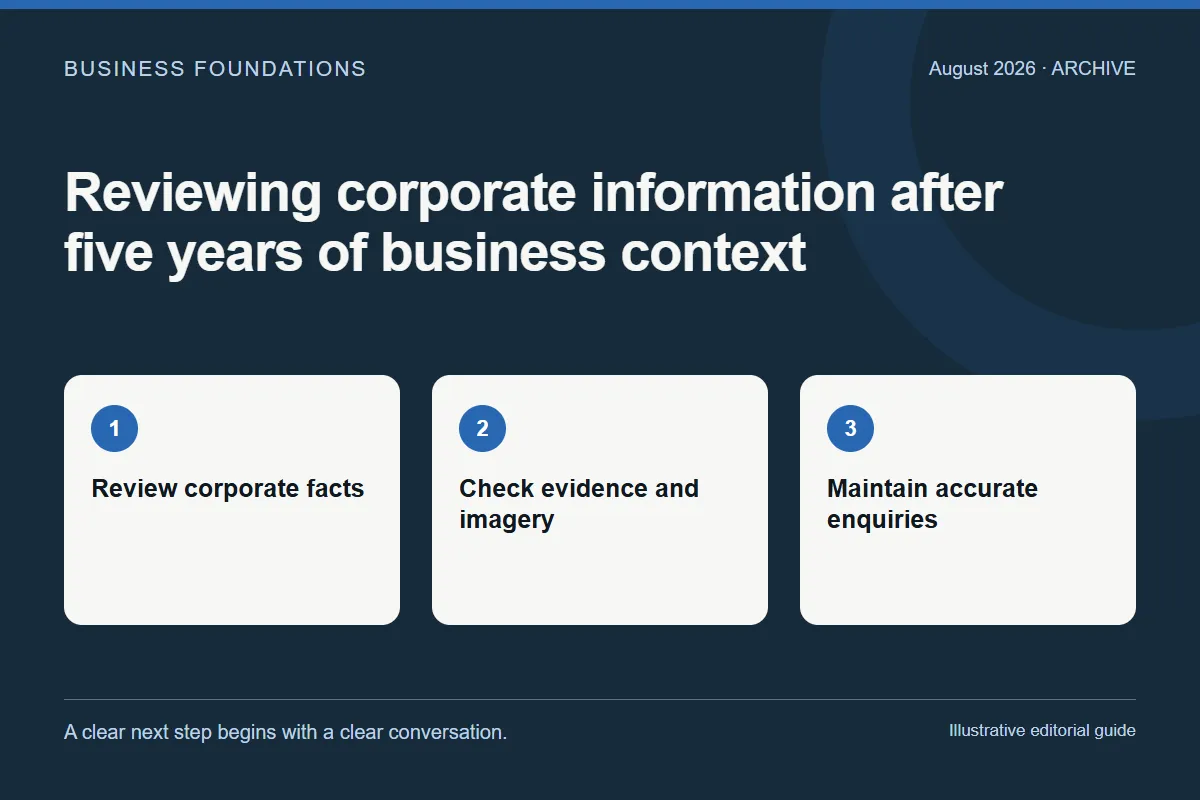
August 2026: Reviewing corporate information after five years of business context
Retrospective archive for August 2026. Prepared on 6 October 2026; this is not an original article from that period.
An archive beginning in August 2021 now spans five years of changing business conditions. August 2026 is a useful editorial checkpoint for reviewing the accuracy of corporate information, without presenting the archive as evidence of company projects or commercial achievements.
Context for the period
The RBA’s August 2026 overview described elevated inflation, input-cost pressures and an economy still facing capacity constraints. Read the contemporary RBA overview.
A practical approach
Check the approved identity, current enquiry scope and maintained contact route. Review documents for unsupported claims, obsolete details and images that need clearer labels. Keep historical context separate from the organisation’s own record. Only genuine approved evidence should support claims about clients, delivery or results.
An illustrative example
For example, a hypothetical information pack includes an illustrative office image. The pack can label it as a concept and explain the business’s current enquiry purpose. It should not describe the scene as the real premises or team. A maintained information pack helps prospective contacts start with accurate expectations.
Three points to take into the conversation
- Review corporate facts
- Check evidence and imagery
- Maintain accurate enquiries
Before progressing the conversation, check that the purpose, current information, responsible contact and next review date are clear. For a corporate-information, supplier or partnership enquiry, contact EJN Services through its own enquiry route.
The economic context comes from the report linked above. The process suggestions and examples are original editorial guidance, not RBA recommendations or records of EJN Services engagements.
